Marquette Historic District Background
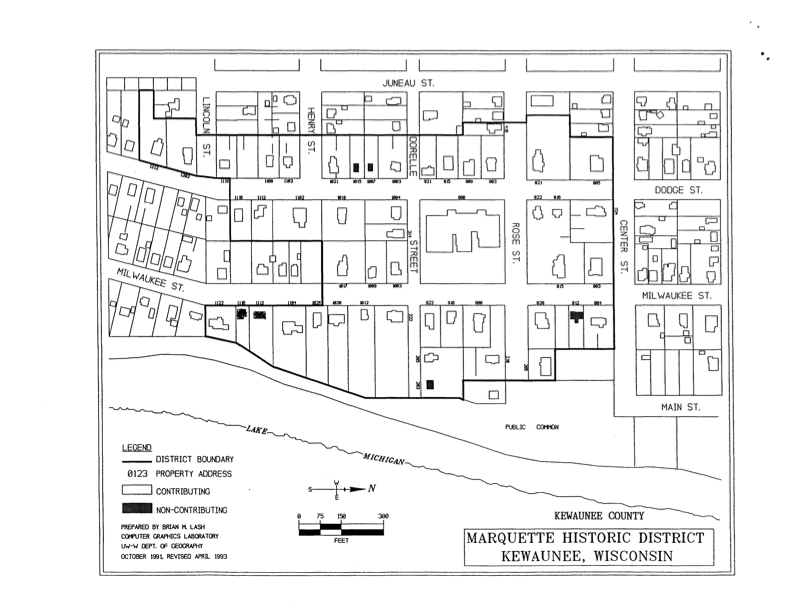
The Marquette Historic District is a small residential neighborhood in Kewaunee, a picturesque small town in northeastern Wisconsin, just at the base of the well-known Door County peninsula. Kewaunee sits on the western shore of Lake Michigan. The town's harbor and much of its downtown sits at lake level. Then the land rises sharply and most of the residential part of the town lies on top of this bluff. The historic district sits at the crest of this bluff just south of the community's downtown. It is a neighborhood of fine, well-maintained homes that sit on large lots with well-kept lawns and mature trees and bushes.
The city streets in the district allow for two-way traffic, and are fully improved with concrete sidewalks, curbs, and gutters. Because of the steep bluff that separates downtown Kewaunee from this district, some streets were lowered to make the rise less steep for automobile traffic. The result is that some houses in the northern part of the district sit above, and not at, street level. While there are no parks within the district boundaries, the large lots of most of the houses and the school grounds, along with lots of trees and bushes give the district a park-like atmosphere. On the eastern boundary of the district is Lake Michigan, which also helps give the district a picturesque quality. There are standard sodium-vapor street lights at various intervals in the district.
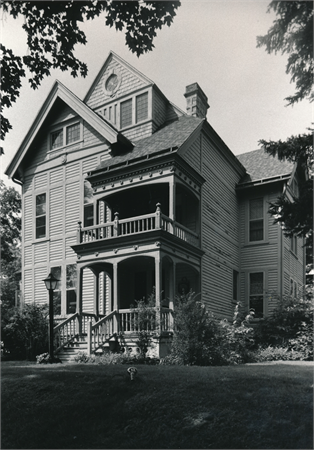
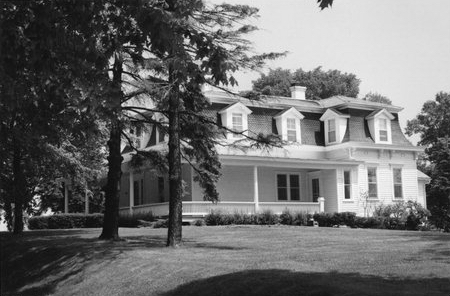
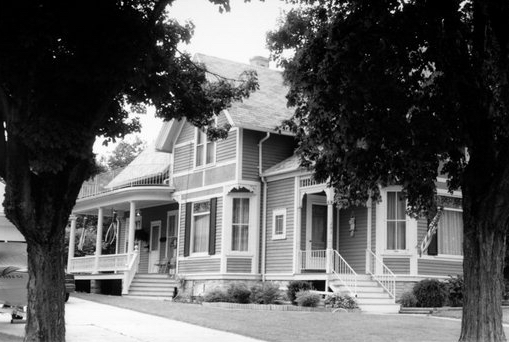
The houses in the Marquette Historic District are largely frame-constructed, two-story buildings. Some of the houses have a brick veneer. They were primarily constructed during that late nineteenth and early twentieth centuries. Of the 42 contributing houses in the district, all but one were built between 1880 and 1940. In fact, six buildings were constructed during the 1880s, nine were constructed during the 1890s, seven were built during the first decade of the twentieth century, 11 were built during the 1910s, and eight were built during the 1920s and 1930s. Even the old Kewaunee Public School (Marquette Middle School) was constructed during this period, between 1914 and 1915.
The concentration of construction in this district during the late nineteenth and early twentieth century is reflected in the architectural styles of the buildings. Only one house was built in the Italianate style, a style popular during the mid-nineteenth century, and that building reflects the style in its later period. Only one house is built in the Second Empire style, a style popular during the mid-to-late nineteenth century. Thirteen houses were built in the popular late nineteenth century Queen Anne style. Nine houses were built in the early twentieth century Bungalow and American Foursquare styles; and nine houses were built in the twentieth century Period Revival styles. Even the vernacular forms in the district largely reflect the building methods and materials of the late nineteenth and early twentieth century.
Most of the houses in the district are two stories in height and are, in most cases, larger than houses in other residential areas of Kewaunee. This is because this area of Kewaunee developed as a prestigious neighborhood for some of Kewaunee's leading business men and their families. Beginning with prominent merchant and pioneer Joseph Duvall, who built the first large house (an Italianate mansion) in the district; and lumber magnate and State Senator George Grimmer, who followed with a Queen Anne house that set the tone for homes soon to follow in the district, many prominent families quickly built showplace homes along Dodge and Milwaukee Streets. In fact, the Marquette Historic District was a veritable "who's who" of prominent families during the late nineteenth and much of the twentieth centuries.
Because the houses in the district are, in general, larger in scale and more elaborate in style than houses outside of the district's boundaries, the Marquette neighborhood is easily distinguished from other residential neighborhoods in Kewaunee. The small residential neighborhood to the north of the district boundaries, and bordering on Kewaunee's downtown, contains many well-preserved mid-nineteenth century houses. While this neighborhood does not fit in with the scale, age, or style of the Marquette Historic District, it is potentially eligible for the National Register of Historic Places in its own right. It could, also, be included within a National Register nomination for Kewaunee's downtown, also a potential historic district.
There are very few non-contributing elements within this historic district. Only four of the 48 buildings in the district have been classified as non-contributing because they have lost most of their architectural integrity, especially in comparison with the high level of preservation and integrity of the rest of the buildings in the district. And, while there are several interesting early twentieth century garages in the district, they and the other extant garages in the district are not significant and are not included in the building inventory or noted on the district map.